To Treasure and Ponder in Your Heart
- Maddi Froiland

- Jan 17, 2020
- 4 min read
Updated: Mar 27, 2020
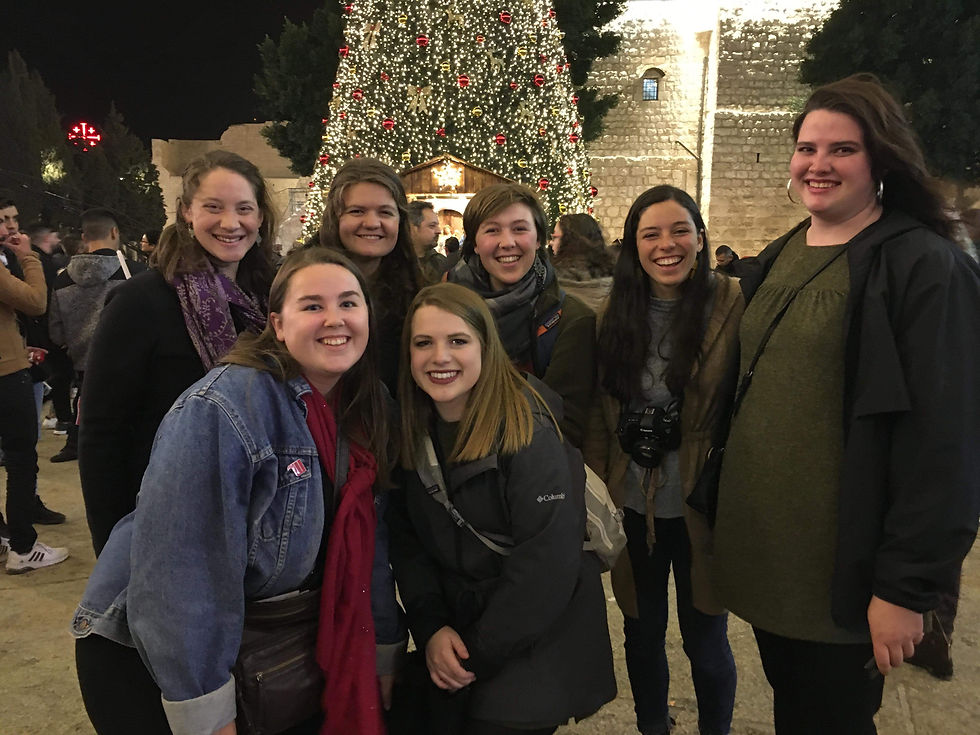
Wrapped in a brand new Palestinian scarf from my amazing host family, I shuffled into a pew in Christmas Lutheran's sanctuary in Bethlehem on Christmas Eve. Pulpit-bound voices recounted Mary and Joseph's journey to the very place in which we all sat, alternating German, Arabic, and English. I listened to the cadence of two languages mostly foreign to me, words or phrases I knew popping out amongst those I didn't. The designated English throughout the service rang clearer than the rest, as my brain could contrastingly process all of English-speaking Pastor Carrie's words.
She arrived at Luke 2:19, "But Mary treasured these things, and pondered them in her heart". Unexpectedly, my vision blurred as my eyes welled with tears.
Mary was just 15 years old when she entered late at night to the streets of the foreign town of Bethlehem, just as I had done that night. Pregnant, relying completely on her much older husband and the hospitality of strangers, she must have been so scared and anxious, yet undeniably strong. Luke could have written that Mary was afraid, too young to really process the situation, or could have not given her any presence in this writing (as is the case with most women in biblical times). Yet he wrote of her reflectiveness, giving us a small insight into Mary's true self and allowing us a small piece of connection with her.
I've heard this verse countless times from childhood pastors and my own mother in the pulpit of various Christmas Eve services. This is the first year I even took note of these words, let alone let them stir my emotions. More than ever before, I could sympathize with young Mary, who was probably also homesick, yet sustained by the hospitality and generosity of the people of Bethlehem.
One of my favorite Christmas songs is "The Christmas Song", (you know,"Chestnuts roasting....on an open fire"). Most of the American Christmas songs have to do with snow, snuggling up to a fireplace, and that warm cozy feeling. This was hard to truly resonate with here, when a late-blooming winter meant we were still experiencing 70's degree days in late December. Unlike my American Christmases, however, people here do actually roast chestnuts over open fires.
"You sing about roasting chestnuts but don't do it, we do it but don't sing about it", my host father joked one night while we were--get this--roasting chestnuts over an open fire.
This night is actually my most salient memory from my Christmas here. It was still about a week before Christmas, and my host family had planned a weekend trip to Nazareth to visit my host sister's future in-laws. Ironically, they were making the exact opposite journey made by Mary and Joseph.
Just as Mary and Joseph were ordered to "register" with the occupying force of their time, individually at some point this fall, each member of my host family had set aside a day to stand in line for up to eight hours and obtain an Israeli-issued magnetic ID. Ideally, this grants them permission to walk through the checkpoint (they are not allowed to travel by bus through the checkpoint) and access some parts of Israel, including Nazareth.
In preparation for this trip, my host mom had asked me to feed their dog the night of their absence, as none of them were going to be home. That night, I walked up the steps to their home and connected to WiFi, only to find a stream of messages from my host father. He explained that he had not made it through the checkpoint, so he and his youngest daughter were home. His final message said "you are welcome to come over if you like".
I walked in to find him carefully making small incisions in chestnuts (a best practice in chestnut-roasting, so the chestnut doesn't explode in the fire), a glass of aroq (like the Greek ouzo) by his side.
"Ahalan Maddi!" (welcome) he said as I walked in the door. "Tfadali" (come and sit), he gestured to the spot on the couch next to him.
I learned the soldiers had given Fadi little explanation for their decision to prohibit his entry to Israel with his family. They had told him that on that particular day, males over 55 years old could not cross, regardless of a hard-earned magnetic ID. He could enter 10 hours after that moment, they told him, if he wanted to wait. No one in the family had heard that rule before. Perhaps it was new, perhaps it was made up. Nevertheless, 10 hours was a good quarter of the trip's planned length; it wasn't worth it to wait.
"But you followed all the rules..." I said, trying, in my very American mindset, to find some kind of function amongst the dysfunction of occupation. He shrugged, and handed me a chestnut.
"And you stood in line and got the ID!" I said.
"Na'am saheh" (yes, true), he said with a big breath, handing me another chestnut.
"Your ID just, didn't matter to them?" I asked.
Another "na'am saheh", another chestnut. Fadi is a very practical man, not one to spend time and energy dwelling on things he has no power to fix (something I greatly admire, and frankly envy of him). I chewed my chestnut uneasily. What is there to do, other than roast chestnuts and drink Aroq in situations like these?
I went with him to feed their dog, my first time meeting her. Our conversation was nothing significant nor deep, yet as we petted and played with Nicki, I (as I always do) found myself laughing at Fadi's relentless sarcasm and sly goofiness. Somehow, between the one of us who was flat-out denied access to a family function that night and the one who holds a passport granting access to the entire country, he was the one cheering me up that night. This is Palestine.
I returned home that night, belly full of open-fire roasted chestnuts, cheeks flushed with aroq, and heart warmed by Fadi's unwavering hospitality and generosity.
There is much I cherish from this Christmas spent in the home of the first Christmas. I ate delicious food, multiple generous people welcomed me into their family Christmas celebrations, I received beautiful gifts from wonderful people, I watched scouts march in the streets, and I listened to my favorite Christmas hymns sung in a new language, among many more more memorable moments.
Through all of this, however, my host dad's serene grace in the face of injustice is what I have and will continue to treasure and ponder in my heart from my Christmas in Bethlehem.




Comments